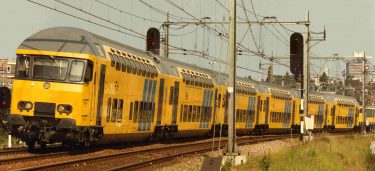
Double-deckers through the years
French double-decker
In the late 1970s, commuter traffic grew explosively, forcing NS to seek additional capacity. Longer trains were not an option because the platform lengths at some stations – including Amsterdam Central – were too short. NS therefore looked to France, where double-decker trains were already in service, and in 1980 tested a French double-decker on the Dutch rail network. However, this train did not meet Dutch requirements: the seating was too narrow, with five seats side by side, and the headroom, at 1.94 metres, was too low for the taller Dutch traveller.
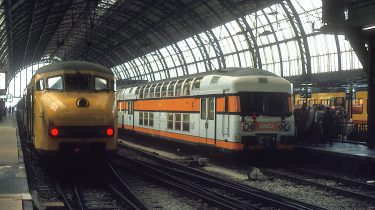
Step one: DDM-1
This led to the development of an in-house design, the DDM-1. The train set attracted a great deal of attention upon its delivery in 1984 and its introduction on the railways in 1985. Passengers could also sit upstairs in the double-decker – how extraordinary that was! These trains had a headroom of 2.01 metres and four seats side by side, which was better suited to Dutch requirements.
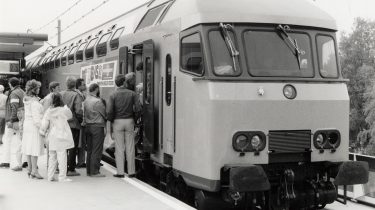
The Elephant
An interesting detail about the first series of DDM-1 coaches is that each driving-end coach featured the name and image of an endangered species, such as the ‘Elephant’ and ‘Seal’. This was an initiative in collaboration with the World Wildlife Fund.
From 2010, NS phased out this first generation of double-deckers, and the ‘Elephant’ control car was transferred to the Railway Museum. However, due to a shortage of rolling stock following a snowy winter, the carriage was loaned back to NS. The ‘Elephant’ has now returned permanently to the Railway Museum and is open to visitors.
A peek inside the original Double-Decker
Further development of DDAR
In the 1990s, this led to the development of the DDAR, a modular double-decker train system capable of being hauled by both locomotives and self-propelled carriages. The reason for this order was the introduction of the public transport student card in 1991, which led to an explosive growth in passenger numbers. The 258 double-decker carriages were built between 1991 and 1994 by Talbot in Aachen and divided into the DDM-2 and DDM-3 series. This made their deployment more flexible and efficient. The DDARs remained in service until 2018, after which many carriages were modernised into the current New Intercity Double-Deck rolling stock, which is still in operation today.
Renewal and modernisation: VIRM series
The VIRM (Verlengd InterRegio Materieel) is the direct successor to the DDAR. The VIRM is a fixed-formation intercity train with integrated engines; unlike the DDAR, it did not require a separate locomotive. These trains underwent several rounds of modernisation to keep pace with changing passenger needs and technological developments. Between 2016 and 2020, 81 VIRM1 trains were fully modernised. This modernisation included a new interior with areas for work and relaxation, energy-efficient LED lighting and improved climate control systems. In addition, wheelchair-accessible toilets and extra luggage space were added.
In 2021, NS unveiled the modernised VIRM 2 and 3 trains. These trains were given a new look, sustainable lighting, modern climate control systems and USB ports in both first and second class. ‘Loveseats’ and ‘stits’ (armchairs) were also added to enhance comfort.
Future: Double-decker New Generation (DDNG)
On 5 March 2025, NS unveiled the New Generation Double-Deck (DDNG). These trains combine single-deck carriages at either end with double-deck carriages in the middle, providing level access for passengers using, for example, a wheelchair or pushchair. Innovations such as high bar tables along the windows and raised seating for four people with extra luggage space have been added to meet a variety of passenger needs. In addition, renewable and recycled materials are used, contributing to the train’s sustainability. The double-decker has thus undergone a steady evolution over the years. By implementing all kinds of innovations, NS continues to focus on improving passenger comfort. Whereas in the 1980s people still read a paper newspaper whilst travelling, nowadays the majority of passengers are more focused on a screen.