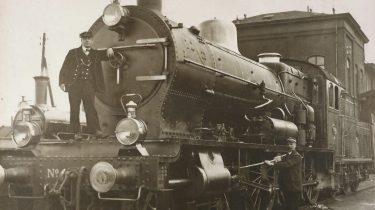
SS 251
The story of ‘the Jumbo’ begins in 1863. The Maatschappij tot Exploitatie van Staatsspoorwegen (‘Company for the Operation of State Railways’) purchased eight locomotives from the English locomotive manufacturer Beyer Peacock & Co.: four passenger locomotives and four freight locomotives. This SS 251 was renumbered to its current SS number in 1886. Following a redesign, the locomotive now featured a small roof to protect the locomotive crew.
The model was built by Ad Werps using brass etched parts.
SS 862
It soon became apparent that these locomotives were not powerful enough for the ever-longer (and therefore heavier) trains. Between 1868 and 1872, the SS 9–78 locomotives entered service. They were succeeded by the SS 300 series, nicknamed the ‘Big Greens’. From 1921, this became the NS 1300. The Railway Museum has preserved the SS 326 from this series. The manufacturer was Beyer Peacock, but the design originated from the Traction Department of the State Railways. They worked under the leadership of the mechanical engineers Stous Sloot and Haagsma. The tractive force had meanwhile been increased from 2,200 kilograms to 4,930 kilograms.
A model of the SS 862, a so-called ‘Hartje’ (translated to ‘heart’, a nickname based on the shape of the front windows of the driver’s cab). The model is by Philotrain.
SS 731
A more powerful locomotive was needed. Ideally, it would have a tractive force of over 9,000 kilograms. Engineers Haagsma and Westendorp, inspired by the ‘Blauwe Brabanders’ of rival NBDS, designed a locomotive with a pulling force that was revolutionary for the Netherlands. A three-axle locomotive, powered by four cylinders. It was extremely reliable and could haul both passenger and freight trains. The SS 685-799 series ran very smoothly thanks to its in-line and side-by-side cylinders. It was also economical in its coal consumption. The new locomotive was popular with the staff and was soon nicknamed ‘Jumbo’. The apple-green livery of the State Railways is a matter of debate; the Railway Museum uses a darker green.
The model of the SS 731 (later NS 3737) is by Artitec.
3771
The Jumbo series was built between 1910 and 1928. Initially, this was carried out by the State Railways’ preferred supplier: Beyer Peacock. When the Amsterdam-based company Werkspoor offered a lower price, the State Railways switched suppliers. At the time, Werkspoor was a newcomer to locomotive construction. Later, further units were also ordered from Germany. In 1917, a partnership was formed between the SS and HSM. Following this, the design of new locomotives was entrusted entirely to the Traction Department of the former State Railways.
Many technically innovative trials were carried out with the 3700 series. Initially under the supervision of engineer Westendorp and later engineer Franco. Examples of some improvements include: (1) a preheating system, (2) a braked running bogie and (3) a four-axle tender with greater coal and water capacity. The Jumbos remained in service until 1957. The last one was the 3737, which was officially handed over to the Railway Museum on 7 January 1958.
The model shown of the 3771 in its post-war version was built from a DJH/ModelLoco kit.
6237
Building on the success of the Jumbo, a freight version followed in 1912. This is the SS 1100 series, later known as the NS 6200 series. Although it was built by the Hohenzollern company in Germany, it bears some resemblance to the Jumbo. Both have the same boiler, but the number of cylinders was reduced to two. Other visible differences included the eight smaller driving wheels, designed to improve adhesion on the rails. Furthermore, the coal and water supplies were carried on the engine itself rather than in a separate tender. This meant the locomotive did not need to be turned round at the end of the journey. This locomotive was specially designed for coal transport in the hilly region of South Limburg. However, it proved so successful that it was later deployed throughout the whole country. For freight trains only, as the permitted maximum speed was just 60 km per hour.
The model of the 6237 belongs to Philotrain.
6005
The Jumbo was essentially designed for long-distance express trains. However, at the beginning of the last century, the phenomenon of commuter traffic emerged. This term refers to daily journeys between home and work. Time was a key factor. On the lines where these trains ran, large numbers of passengers were transported over short distances in a short space of time. A locomotive with a separate tender had to travel to a turntable for the next journey. After turning round there, it could then return to the train. The ‘Tenderjumbo’ was designed for these commuter trains. A lookalike of the 3700 series, but with its coal and water supply on the locomotive itself. Unfortunately, a full-scale locomotive was not feasible, as the track on the routes could not support the total weight. Consequently, the 6000 series was built with only two in-line cylinders and a limited water supply.
For the construction, the SS returned to Beyer & Peacock. Of the forty locomotives ordered, only twenty-six were actually delivered. The rest had been requisitioned by the British government for the warfare in north-western France. The Dutch locomotives fulfilled their duties and became particularly well known for their service on the Gooise Lijn. This line ran from Amsterdam Central Station to Amersfoort.
The 6005 model with small water tanks is made by Philotrain.
6101
It was not until 1928 that the Dutch railways were robust enough to build a full-scale tender locomotive based on the Jumbo. By then, this was also economically viable. Meanwhile, the electrification of the railways was already underway. No more than ten units of the 6100 series were built.
The model of the 6101 shown here was built by Ad Werps from a GM&S kit.
9505
The odd one out in the family was the 9500 series, which had a smaller boiler. It was a locomotive specially designed for the steep gradients in South Limburg.
The model is built by Philotrain.
4614
The 4600 series transported coal from South Limburg to the rest of the Netherlands.
The model is built by Philotrain.
3917
The 3900 series was introduced in 1929. They were an enlarged version of the Jumbo, and therefore even more powerful.
The model produced by Philotrain from DJH/ModelLoco.
6317
The Traction Department of the Dutch Railways designed a freight version of the 3900. The 6300 series entered service in 1930.
The model was produced by Philotrain.