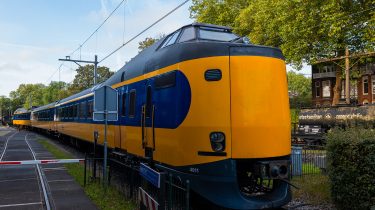
'Doorloopkop'
The name is based on the so-called doorloopkop (walk-through head). Beneath the raised driver’s cab was a passageway where passengers and staff could walk to the other train set via a retractable chute. Consequently, there were doors in the nose of the train. However, in 2005, NS decommissioned the walk-through heads. They were prone to breakdowns and wear and tear; moreover, many passengers found the dark and narrow passage a bit scary. They were rarely used. During the modernization of the Koplopers, the walk-through heads were taken out of service, and the two nose doors were replaced by a lightweight polyester panel. The 4011 is preserved by the museum in this state.
Design
The design of this train incorporated several new concepts. The trainsets are equipped with a large balcony with space for wheelchairs. Contrary to what is customary for Intercity rolling stock, the Koploper does not have a restored section. There is a small kitchenette for making coffee and tea. One header carriage powers all four axles. In addition to disc brakes, the trainset is equipped with a block brake to allow for faster deceleration. The entire trainset features automatically closing doors that remain locked during the journey and contains three toilets. The train is designed for a maximum speed of 160 km/h.
Career
Trainset 4011 rolled out of the Talbot workshop in Aachen on December 14, 1983. Immediately afterwards, the trainset was transferred to the climate chamber in Vienna, where the train was extensively tested for its reliability under extreme climatic conditions. The train passed with flying colours at the time. The 4011 had an interesting career during its forty-year existence. Between 1986 and 2002, the Koplopers were regularly adorned with full livery. This began as an idea by NS to enhance the opening of the Schiphol line by giving the trains the same paint scheme as airplanes. It came in handy that the Koploper’s design bared some resemblance to a Boeing 747. The 4011 was decked out in KLM colours, the 4012 in Martinair colours. Later, the 4011 ran for a while in Aegon colours.